




This weekend, Morgunblaðið (Iceland’s main newspaper) published an article by Pétur Magnússon, General Manager of Frumtök, on why medication should be reviewed regularly. The article follows the symposium “Lyfjasúpan” (roughly, “the medication soup”). The National Association of Senior Citizens in Iceland held the symposium recently in Reykjavik. Speakers discussed medication use among older people and how to support high-quality treatment, better follow-up and a better quality of life.
English translation of the article is below:
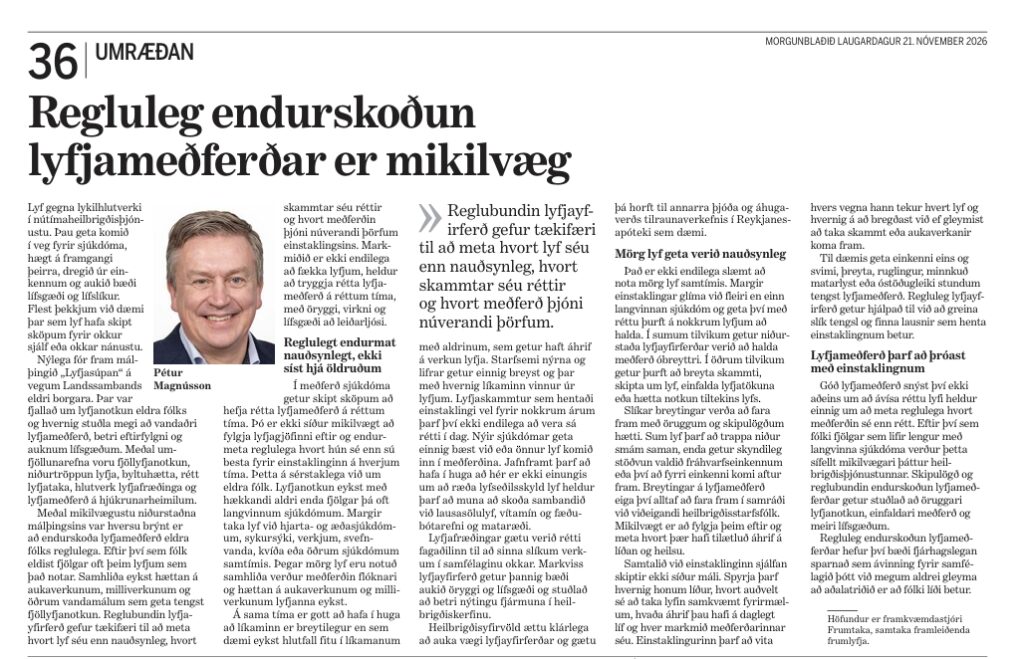
Regular review of medication is important
Medicines play a key role in modern healthcare. They can prevent disease, slow its progression, relieve symptoms and improve both quality of life and life expectancy. Most of us know of cases where medicines have made a decisive difference for ourselves or for those closest to us.
The National Association of Senior Citizens in Iceland recently held a symposium called “Lyfjasúpan” (roughly, “the medication soup”). It focused on medication use among older people and on how to support high-quality treatment, better follow-up and a better quality of life. Topics included polypharmacy, deprescribing, the risk of falls, taking medicines correctly, the role of pharmacists and medication management in nursing homes.
One of the most important conclusions of the symposium was that older people’s medication needs to be reviewed regularly. As people get older, the number of medicines they take often increases. At the same time, the risk of side effects, drug interactions and other problems linked to polypharmacy rises. A regular medication review is a chance to check whether each medicine is still needed, whether the doses are right and whether the treatment meets the person’s current needs. The aim is not necessarily to reduce the number of medicines. It is to make sure people get the right treatment at the right time, with safety, effectiveness and quality of life as the guiding principles.
Regular reassessment is essential, especially for older people
When treating disease, starting the right medicine at the right time can be crucial. It is just as important to follow up on the treatment and to reassess regularly whether it is still the best option for the person. This applies especially to older people. Medication use increases with age, as chronic conditions often become more common. Many people take medicines for cardiovascular disease, diabetes, pain, sleep problems, anxiety or other conditions at the same time. When several medicines are used together, treatment becomes more complex and the risk of side effects and interactions increases.
It is also worth remembering that the body changes with age. For example, the proportion of body fat increases, which can affect how medicines work. Kidney and liver function can also change, and with it the way the body processes medicines. A dose that suited someone well a few years ago may therefore not be the right one today. New conditions may develop, or other medicines may be added to the treatment. Prescription medicines are also not the only thing to consider, because over-the-counter medicines, vitamins, dietary supplements and diet can all affect treatment.
Pharmacists could be the right professionals to carry out this kind of medication review. Targeted medication reviews can improve both safety and quality of life and help make better use of healthcare resources. The health authorities should clearly give medication reviews greater weight. They could look, for example, to the experience of other countries and to an interesting pilot project at Reykjanesapótek pharmacy.
Several medicines may be necessary
Taking several medicines at once is not necessarily a bad thing. Many people live with more than one chronic condition and may genuinely need several medicines. In some cases, a medication review may conclude that the treatment should stay as it is. In other cases, it may be necessary to adjust a dose, switch medicines, simplify the regimen or stop a particular medicine.
Such changes must be made safely and in a structured way. Some medicines need to be tapered gradually, because stopping suddenly can cause withdrawal symptoms or make earlier symptoms return. Changes to medication should therefore always be made in consultation with the appropriate healthcare professionals. It is important to follow them up and assess whether they have the intended effect on the person’s health and well-being.
The conversation with the person is just as important. They should be asked how they feel, whether it is easy to take the medicines as instructed, how the medicines affect daily life and what the goals of treatment are. People need to know why they take each medicine and what to do if they forget a dose or experience side effects.
Symptoms such as dizziness, fatigue, confusion, loss of appetite or unsteadiness can sometimes be linked to medication. A regular medication review can help identify such links and find solutions that suit the person better.
Medication should evolve with the person
Good treatment is therefore not only about prescribing the right medicine. It is also about regularly assessing whether the treatment is still right. As more people live longer with chronic conditions, this is becoming an ever more important part of healthcare. A structured, regular review of medication can lead to safer medicine use, simpler treatment and a better quality of life. It can also bring financial benefits to society, but we must never forget that what matters most is that people feel better.